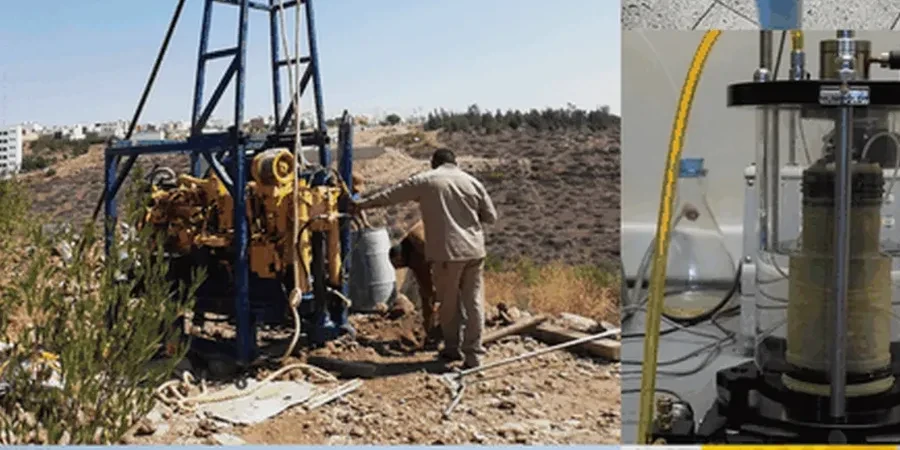
A set of Shelby tubes, a dynamic cone penetrometer, and a survey level are the first tools on site when investigating the complex ground profile beneath York. The city sits at the confluence of the Rivers Ouse and Foss, at an elevation of roughly 13 metres above ordnance datum, and our soil mechanics study regularly encounters a layered sequence of firm to stiff glacial till overlying softer alluvial clays and sands. We extract undisturbed samples from boreholes advanced through the weathered zone, then subject them to triaxial compression and oedometer consolidation back in our laboratory. For granular layers that collapse during sampling, we run in-situ standard penetration tests to capture relative density. A thorough soil mechanics study here must resolve the transition between the York Moraine deposits and the lacustrine clays that blanket the eastern approach roads, because differential settlement can appear where these units pinch out over short distances. When the upper fill layers exceed 2 metres, we often recommend complementing the borehole campaign with test pits so the supervising engineer can log the contact between made ground and natural strata directly, a practice that catches old cellars and medieval backfill before they compromise piling rigs.
Getting the undrained shear strength of the glacial till right is the difference between an economical pad footing and an over-designed piled solution in York.
Process and scope
Local ground factors
York recorded a population of 141,000 in 2023, and the pressure to build on brownfield land inside the outer ring road exposes projects to ground that has already been disturbed by centuries of occupation. A soil mechanics study that skips chemical testing can miss sulphate concentrations high enough to degrade concrete in buried foundations, a risk the Building Research Establishment classifies under BRE Special Digest 1. Equally dangerous is assuming the laminated clay behaves as a free-draining material: its low vertical permeability delays pore pressure dissipation, so temporary works for a basement excavation near the Foss can become unstable during a wet winter if the designer relied on drained parameters alone. Our soil mechanics study reports always include an explicit statement on groundwater regime, because the Ouse's floodplain responds to seasonal fluctuations of over 2 metres, and a shallow foundation designed for summer water levels can lose half its effective bearing area by February.
Relevant standards
BS 5930:2015+A1:2020 – Code of practice for ground investigations, BS EN 1997-1:2004 – Eurocode 7: Geotechnical design – General rules, BS EN 1997-2:2007 – Eurocode 7: Geotechnical design – Ground investigation and testing, BS 1377:2018 – Methods of test for soils for civil engineering purposes, BRE Special Digest 1:2005 – Concrete in aggressive ground
Other technical services
Laboratory Strength & Compressibility Testing
Consolidated-undrained and drained triaxial tests on 100 mm Shelby tube samples from the glacial till and alluvium, plus incremental oedometer tests to derive constrained modulus and preconsolidation pressure. Every specimen is logged for fabric, fissuring, and organic content before shearing.
In-Situ Penetration & Sampling Campaigns
Boreholes advanced with dynamic sampling and SPT at 1.5 m intervals through the weathered crust, targeting the sand lenses within the till that control drainage. We install standpipe piezometers in selected boreholes to monitor groundwater recovery over a 48-hour period.
Chemical Aggressivity & Geoenvironmental Screening
pH, sulphate, and chloride profiling on disturbed samples from each strata change, with BRE SD1 classification to specify the correct concrete design chemical class. Where historical maps indicate former industrial use, we add heavy metal and hydrocarbon suites.
Typical parameters
Quick answers
What is the typical cost of a soil mechanics study in York for a single dwelling?
For a residential plot with a borehole to 8–10 metres, laboratory testing on three samples, and a factual report, the cost usually falls between £2,220 and £3,880. The spread depends on access constraints, depth to competent bearing stratum, and whether groundwater monitoring is required for the planning condition.
Which British Standards govern soil mechanics studies in the UK?
The core documents are BS 5930:2015 for ground investigation procedures, BS EN 1997 Parts 1 and 2 (Eurocode 7) for geotechnical design and testing, and BS 1377 for laboratory methods. For concrete durability in aggressive ground, BRE Special Digest 1 applies.
How deep should a soil mechanics study go for a piled foundation in York?
Piles in York typically penetrate the glacial till and socket into the underlying Sherwood Sandstone or Permian mudstone. We usually extend the investigation to at least 5 metres below the anticipated pile toe, or 3 times the pile diameter, whichever is greater, to check for weak layers that could cause punching failure.
Is a soil mechanics study mandatory for a basement extension in York?
Yes. A basement in York's floodplain requires a geotechnical design report under Eurocode 7, which must be supported by a soil mechanics study that quantifies lateral earth pressures, groundwater uplift forces, and the shear strength of the soil behind the retaining wall. Without it, building control will not sign off the structural calculations.