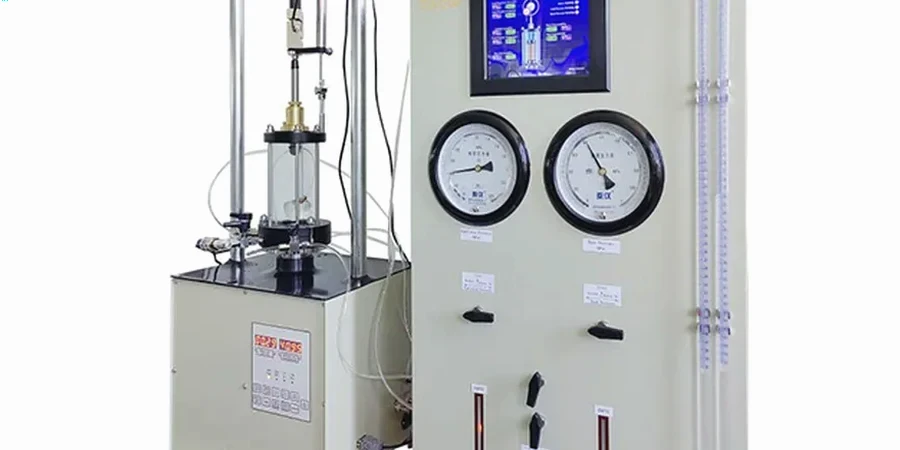
The Vale of York sits on a deep basin of glacial and post-glacial deposits, with the York Moraine forming a subtle ridge of sandy gravels across the city. Beneath the historic centre, alluvial clays and silts from the River Ouse dominate, often with organic lenses that go unnoticed until a borehole log flags them. In our experience, these soft cohesive layers control foundation performance far more than the overlying made ground. A triaxial test on undisturbed Shelby tube samples reveals the effective stress parameters that standard penetration tests simply cannot. For sites near the river, where groundwater fluctuates by up to 3 metres seasonally, the drained shear strength from a multi-stage triaxial test becomes the cornerstone of any safe design. We complement fieldwork with in-situ permeability measurements to characterise drainage conditions around the sample depth before running the triaxial programme.
Effective stress parameters from a triaxial test let the engineer separate the load carried by the soil skeleton from the pore water pressure — a distinction that matters enormously in York’s floodplain clays.
Process and scope
Local ground factors
York’s position on the River Ouse floodplain creates a risk that drier weather can mask. After a wet winter, the water table rises and saturates the alluvial clays, reducing their effective stress and bringing the factor of safety down. If the designer has relied on total stress parameters from a quick undrained test on a summer sample, the winter reality can be dangerously different. In our laboratory, we routinely run consolidated-drained and consolidated-undrained triaxial tests on specimens saturated to match the worst-case groundwater scenario. This approach follows BS 1377-8:1990 and Eurocode 7 principles, and it has helped several projects near the Foss Basin avoid costly underpinning later. A CPT test before sampling helps identify the critical layers, so the triaxial testing focuses on the soil that actually governs stability.
Relevant standards
BS 1377-8:1990 — Shear strength tests (effective stress), BS EN 1997-2:2007 (Eurocode 7) — Ground investigation and testing, BS 5930:2015+A1:2020 — Code of practice for ground investigations
Other technical services
Multi-stage triaxial testing
We run three effective confining pressures on a single specimen to define the Mohr-Coulomb failure envelope. Suited to sites where only limited undisturbed material is available, such as deep alluvial clays beneath York city centre.
Consolidated-undrained testing with pore pressure measurement
We saturate the specimen under back pressure, consolidate it to the estimated in-situ stress, and then shear it undrained while recording pore water pressure. This yields both undrained shear strength and effective stress parameters from one test.
Typical parameters
Quick answers
How long does a triaxial test programme take in your York laboratory?
A standard set of three effective stress triaxial tests on cohesive soil usually takes between 7 and 10 working days from sample receipt. Consolidated-drained tests on sands run faster, often 5 to 7 days. We can expedite reporting when the site programme requires it.
What is the cost range for a triaxial testing programme on a York project?
A typical triaxial testing programme for a single borehole depth — three specimens tested at different confining pressures — ranges from £1,660 to £2,450, depending on the test type and whether multi-stage or individual specimens are used.
How do you protect samples of York alluvial clay during transport?
Samples are extruded from the Shelby tubes on site, wrapped in cling film and aluminium foil, sealed with wax, and placed in rigid plastic sleeves inside cool boxes. We deliver them to the laboratory within 24 hours and store them in a humidity-controlled room at 10 °C until testing.
Which triaxial test type is most suitable for the glacial till found west of York?
For the stiff, low-plasticity glacial till typical of the Acomb and Poppleton areas, we recommend consolidated-undrained tests with pore pressure measurement. The till is often fissured, so full saturation and back pressure are essential to obtain representative effective stress parameters.