In York, the conversation around seismic design often gets sidelined because we don't feel big shakes here. But anyone who has worked on sensitive retrofit projects in the city centre, or on new infrastructure near the River Ouse floodplain, knows that vertical ground motion from distant events still travels through the soft alluvium. We've seen how a 4.5 magnitude tremor in the North Sea can excite a stiff masonry structure on shallow pad footings. Base isolation isn't just for high-seismicity zones; it's a tool to decouple a building from ground-borne vibration when the soil profile amplifies even modest energy. Our team has applied seismic microzonation studies to map how the glacial till and post-glacial sands east of the A64 respond differently from the Mercia Mudstone to the west, and that local variation drives isolator selection. A well-designed isolation layer reduces demand on the superstructure so significantly that we often preserve original Victorian brickwork without invasive strengthening. For deeper soil profiles we frequently pair this with a MASW survey to nail down the Vs30 value before finalising the bearing details.
Base isolation in a low-seismicity city like York isn't about surviving the big one; it's about eliminating operational downtime from modest tremors that the local soil column amplifies.
Process and scope
Local ground factors
York sits at roughly 15 metres above sea level, and its post-glacial history left a layered sequence of soft clays, silts, and peat pockets that don't appear on the 1:50,000 BGS map at the detail you need for isolation design. The real risk we encounter on site isn't the seismic hazard itself—it's the lateral variability of the ground within a single building footprint. A 2019 project near Walmgate showed a 12-metre drop in rockhead across just 40 metres, which would have put half the isolators on competent mudstone and half on compressible organic silt. That kind of differential stiffness creates torsional response even under weak ground motion, and once the isolation layer starts rotating, the displacement demands on the perimeter bearings can double. We mitigate this by running closely spaced CPT soundings across the footprint, which gives us a continuous stiffness profile that a handful of boreholes simply cannot provide. Ignoring the glacial channel infill that runs beneath parts of the city centre is the fastest way to an underperforming isolation system.
Relevant standards
BS EN 1998-1:2004 (Eurocode 8: Design of structures for earthquake resistance), BS EN 1997-1:2004 (Eurocode 7: Geotechnical design), BS 5930:2015 + A1:2020 (Code of practice for ground investigations), BS EN 15129:2018 (Anti-seismic devices)
Other technical services
Isolator selection and preliminary sizing
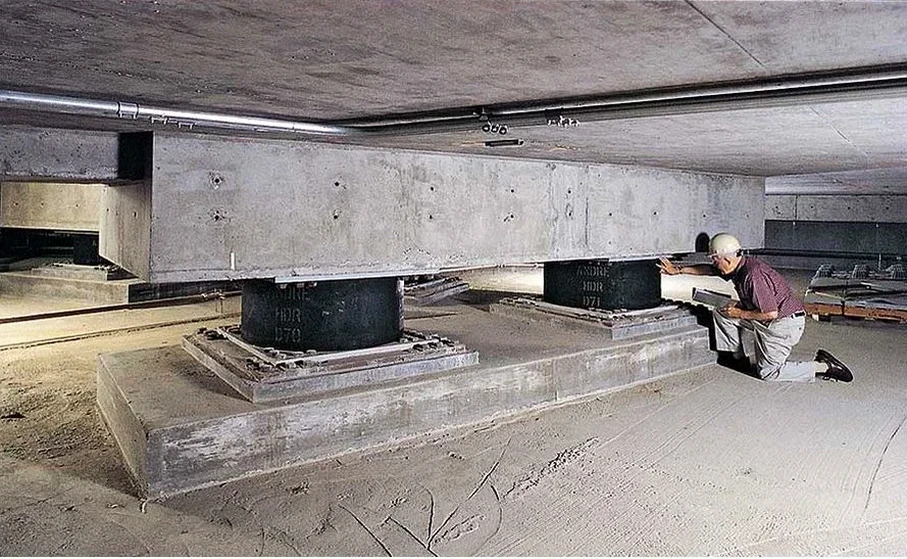
We compare elastomeric and sliding systems against the site-specific response spectrum, checking displacement capacity, recentring behaviour, and aging effects per BS EN 15129.
Site-specific ground motion assessment
Using borehole data and geophysical surveys, we build a 1D shear wave velocity model to compute site amplification factors that feed directly into the isolation period selection.
Construction-stage QA and bearing testing
We supervise isolator installation, verify plinth flatness tolerances, and witness prototype testing to ensure the production bearings match the design hysteresis loops.
Typical parameters
Quick answers
How much does a base isolation seismic design package cost for a project in York?
For a typical mid-rise building in the York area, the combined cost of the site investigation, laboratory testing, isolator design, and construction-phase oversight usually falls between £3.590 and £6.390. The final figure depends on the number of isolators, the complexity of the ground profile, and whether we need supplementary geophysical surveys.
Does York really need seismic isolation given the low seismicity?
The British Geological Survey records dozens of small to moderate events in the UK each year, and the soft alluvial soils under central York amplify even distant tremors. Base isolation isn't just about collapse prevention; it protects sensitive equipment, reduces post-earthquake downtime, and often lets you avoid heavy structural reinforcement in heritage buildings where alteration is restricted.
Which isolator type works best on the Mercia Mudstone found under much of York?
The Mercia Mudstone provides a stiff, competent bearing stratum, so we can design for a shorter isolation period without excessive displacement. Lead rubber bearings tend to work well here because the compact mudstone limits rotation and allows us to exploit the LRB's high initial stiffness for wind loads. On the deeper alluvium near the Ouse, we sometimes shift to high-damping rubber bearings to manage larger displacements.