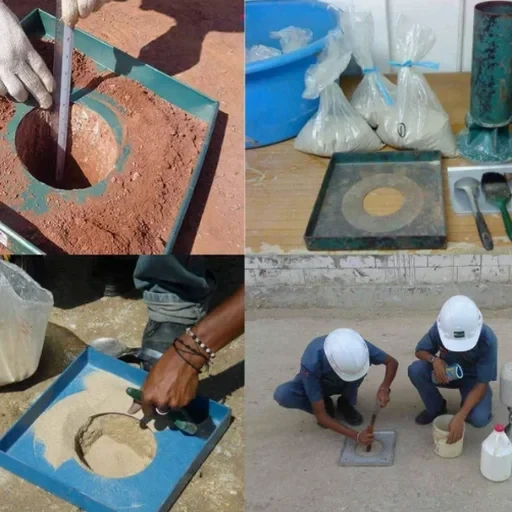
York's geological makeup splits the city in two. West of the River Ouse, you hit stiff glacial till and gravels that compact well under controlled moisture. East of the Foss, the ground shifts to soft alluvial clays and silts where compaction is harder to achieve and even harder to verify. This contrast matters when you lay a sub-base for a carriageway on the ring road or backfill a trench along Bishopthorpe Road. The sand cone test gives us a direct, physical measurement of in-place density right at the compacted surface. No lab inference, no waiting days for a result. We pair the test with a grain size analysis when the spec calls for grading verification on the same material, and we often run an in-situ permeability test on drainage layers beneath permeable paving. The team works across the Vale of York, from Haxby to Fulford, and the method remains the most practical reference standard for earthworks acceptance under UK highways specifications.
Compaction acceptance isn't about a number on a gauge. It's about a physical hole, calibrated sand, and a verifiable density that holds up in wet York winters.
Process and scope
Local ground factors
York's winter groundwater and summer shrinkage cycles create a testing environment where timing is everything. Saturated clay fill tested in January can pass density but fail months later once it dries and loses volume. The risk is compaction acceptance based on a single moisture condition that doesn't reflect the soil's behaviour across seasons. We see this most often in trench reinstatements along narrow streets in the city centre, where utility crews backfill with clay and a density test looks fine on the day but the pavement subsides by autumn. The sand cone method works because it's direct, not indirect like a nuclear gauge, but it demands careful hole preparation and zero sand loss. We document every test with a location plan, layer thickness, and weather condition. When the material is borderline, we recommend a plate load test on the same lift to confirm stiffness, not just density, and settle disputes before the pavement team arrives.
Video overview
Relevant standards
BS 1377-9:1990 — In-situ density tests (sand replacement method), BS 1924-2:2018 — Stabilized materials: compaction and density, Eurocode 7 (BS EN 1997-2:2007) — Ground investigation and testing, Manual of Contract Documents for Highway Works (MCHW), Series 600
Other technical services
Compaction Verification for Roads and Hardstanding
Single or grid-pattern sand cone tests on sub-base and capping layers prior to surfacing. We reference SHW Series 600 and provide immediate pass/fail results with moisture correction. Covers residential access roads, car parks, and industrial yards across York.
Trench and Utility Backfill Testing
Sand cone density checks on reinstated trenches for water, gas, and fibre utilities. We test in confined zones, often working around live services, and issue certificates aligned with local authority adoption requirements and Yorkshire Water specifications.
Typical parameters
Quick answers
What does a sand cone density test cost in York?
A single sand cone test typically runs between £80 and £130, depending on site location within York and the number of points needed on the same visit. Grid testing on larger earthworks sites brings the per-point cost down. We provide a fixed quote before mobilisation.
How many test points do I need for a road sub-base?
The Manual of Contract Documents for Highway Works generally specifies one test per 1000 m² per compacted layer, with a minimum of three points per area. For smaller residential drives or access roads in York, we adapt the grid spacing to the site geometry and client specification.
Can you test in wet conditions after rain?
We can, but the result reflects the density at that moisture state. If the soil is near saturation, the dry density will read lower than during optimum conditions. We record weather and surface conditions on the report so the engineer can judge whether re-testing after drying is necessary.
What's the difference between the sand cone and a nuclear density gauge?
The sand cone is a direct volume-and-mass measurement. A nuclear gauge infers density from gamma radiation backscatter or transmission. Sand cone results are more defensible for acceptance disputes, and in the UK the sand replacement method remains the reference standard under BS 1377-9, though nuclear gauges are faster for production control.