The most expensive mistake we see on York construction sites is assuming that deep densification isn't necessary just because the top metre looks firm. Beneath the surface, the River Ouse and its tributaries have deposited loose, water-laden silty sands across the Vale of York, and these layers compact unpredictably under structural load. A generic ground improvement specification without a site-specific vibrocompaction design often leads to excessive differential settlement within the first two years of service, cracking partition walls and misaligning lift shafts. Our approach starts with the granular soil gradation and fines content, because vibrocompaction only works efficiently when the percentage passing the 0.074 mm sieve stays below 12-15%. Before finalising any compaction grid, we routinely integrate findings from a cpt-test to map the loose pockets along the proposed foundation footprint, and we cross-reference those cone resistance profiles with the local borehole logs archived by the British Geological Survey for the York district.
In York's floodplain geology, effective vibrocompaction design is less about reaching a target SPT N-value and more about closing the soil's grain-to-grain void ratio before the structure imposes its permanent load.
Process and scope
Local ground factors
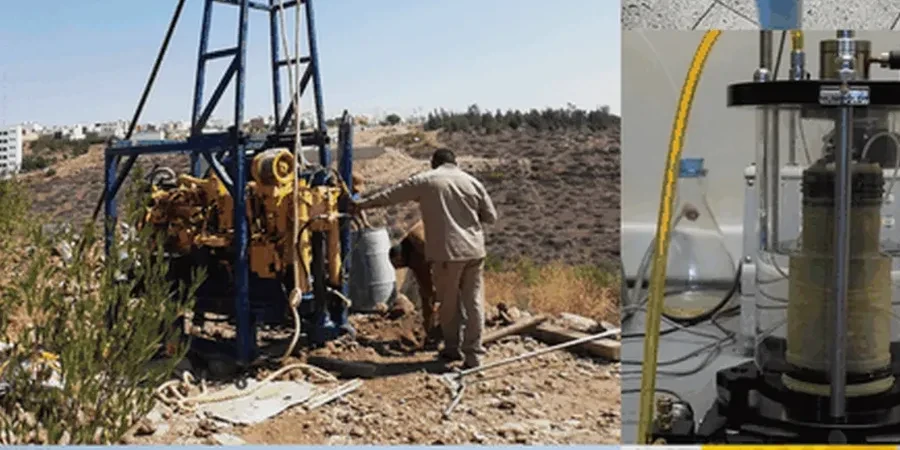
On the western bank of the Ouse, we frequently encounter a specific stratigraphic trap: a desiccated crust of stiff clay overlying loose, saturated fine sand at about three metres depth. This crust masks the true settlement potential during a routine window sampler survey, and only a cone penetration test reveals the dramatic drop in tip resistance below the water table. The hazard is not total collapse but differential settlement, where one corner of a steel-frame building settles 40 mm while the opposite corner remains stable, tearing the cladding and jamming the fire doors. York's flood history compounds the problem: a wet winter raises the regional groundwater table by over a metre, temporarily saturating the silt layers and reducing the vibrator's effectiveness if the treatment is scheduled without considering seasonal pore pressure. Our design sequencing therefore specifies a dewatering phase or a seasonal construction window, followed by a strict quality control protocol using post-compaction CPT soundings at 5% of the improvement points.
Relevant standards
BS 5930:2015 – Code of practice for ground investigations, BS EN 1997-1:2004 (Eurocode 7) – Geotechnical design, BS EN 1998-5:2004 – Siting and foundation requirements in seismic areas
Other technical services
Feasibility and Granulometric Screening
We test soil gradation from rotary boreholes against the vibrocompaction applicability envelope, quantifying fines content and uniformity coefficient to confirm that the York sands will densify under vibratory energy.
Trial Zone and Grid Optimisation
A full-scale trial on-site, typically involving nine compaction points, defines the optimal spacing, vibrator power, and hold time. We log settlement per pass and adjust parameters until the target cone resistance is achieved.
Production Design and QC Specification
We issue the construction drawings with grid coordinates, treatment depths, and acceptance criteria based on post-compaction CPT and zone load tests, all documented in a verifiable format for building control sign-off.
Typical parameters
Quick answers
How do you determine whether vibrocompaction will work on our York site?
The decision hinges on the grain size distribution curve. We need a minimum of three boreholes with SPT samples and sieve analyses across the footprint. If the fines content passing the 63 μm sieve is consistently below 12% and the coefficient of uniformity exceeds 1.5, vibrocompaction is technically feasible. We then run a CPT campaign to identify the loose zones and confirm that the water table is accessible for saturation, because dry sands above the phreatic surface respond poorly to vibratory energy without water jetting.
What verification do York building control officers require after vibrocompaction?
City of York Council typically accepts a combination of post-treatment CPT soundings and zone load tests. We specify a minimum of one CPT for every 20 compaction points, with the acceptance criterion being a cone resistance profile that exceeds the design target across the full treatment depth. A zone load test on a 1 m² plate is often required for commercial structures, demonstrating a settlement of less than 25 mm under 1.5 times the design bearing pressure, in compliance with Eurocode 7 serviceability requirements.
How long does a vibrocompaction design and execution take in York?
The design phase, including a trial zone with nine compaction points and post-trial CPT verification, typically takes two to three weeks from mobilisation to final report. Full production across a 2,000 m² footprint might require an additional two weeks of single-shift operation, weather permitting. We always recommend scheduling the treatment between May and September, because York's high winter groundwater levels can delay compaction and increase the energy required to achieve the target density.
What is the typical cost range for vibrocompaction design in York?
For a typical commercial project in the York area, the combined design, trial zone, and production phase costs range from £1,160 for a small residential extension up to £4,320 for a full industrial unit pad, depending on the treatment depth, grid density, and the number of verification CPTs required by building control. Each project receives a fixed-price proposal after we review the preliminary borehole logs and the foundation layout, so there are no surprises midway through the ground improvement.
Can vibrocompaction be used near York Minster or other historic structures?
Yes, but with strict vibration monitoring. We install triaxial geophones on the nearest heritage asset and set a peak particle velocity threshold, usually 5 mm/s at frequencies below 10 Hz, as agreed with the council's conservation officer. If the monitoring approaches this limit, we reduce the vibrator frequency or switch to a smaller eccentric weight. In extreme cases near very fragile masonry, we redesign the treatment as stone columns installed with a displacement auger, which generates significantly lower ground-borne vibration.