When you're working on pavement design in York, the moisture-sensitive glacial clays beneath the city will dictate your sub-base thickness more than the traffic loading ever will. That's something you learn after processing hundreds of samples from sites around the Vale of York. We run all CBR tests in our laboratory under controlled conditions, using BS 1377: Part 4 procedures. The compaction effort is matched to the expected field density; we don't just hammer a sample and hand you a number. For projects near the River Ouse floodplain, where groundwater can sit less than a metre down, the soaked CBR value often drops to a third of the unsoaked figure. We flag that early because it changes the pavement section completely. Before committing to a formation level, a CPT test across the site gives us a continuous profile of the subsurface variability that the CBR samples alone cannot capture.
A soaked CBR value from a York glacial clay tells you more about long-term pavement performance than any unsoaked result.
Process and scope
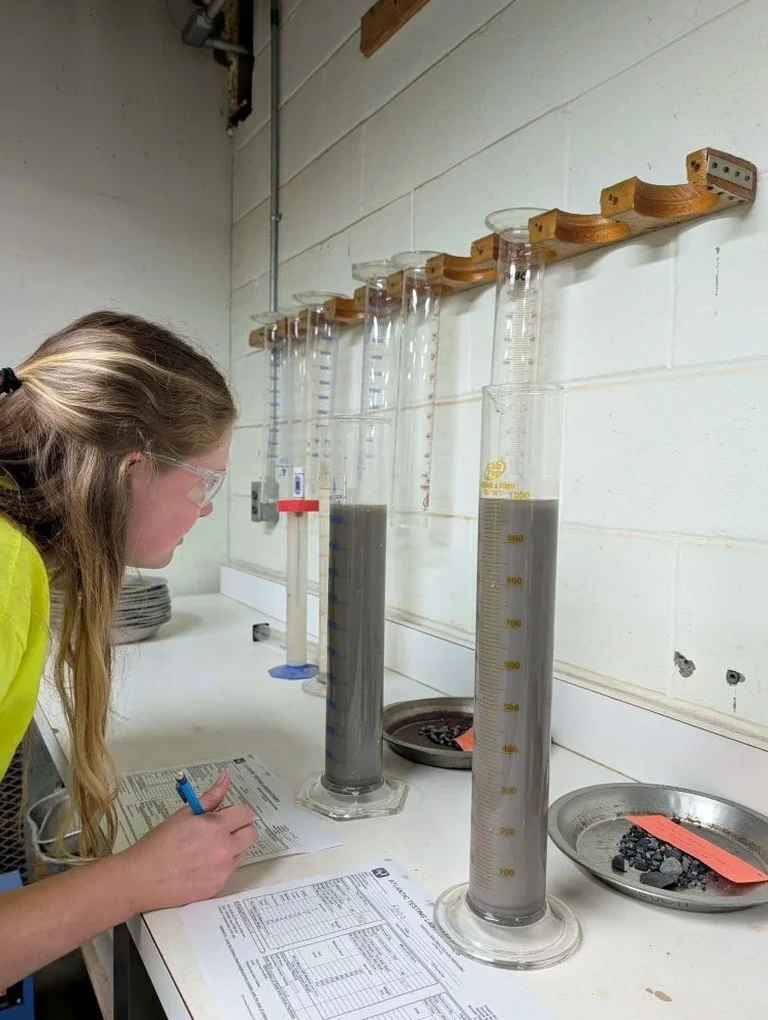
Local ground factors
The contrast between York's relatively dry summers and prolonged wet winters creates a testing challenge: a subgrade that looks competent in September can be a slurry by February. Skipping the four-day soak during laboratory CBR testing masks this vulnerability entirely. We have seen projects where unsoaked CBR values above 15% collapsed to less than 3% after soaking, forcing a complete redesign of the capping layer. The laminated clays found in the York area are particularly sensitive to moisture changes; they lose structure rapidly once the natural suction is removed. Our protocol always includes both unsoaked and soaked determinations, and we record the swelling percentage during soaking as a separate indicator of volumetric instability. For brownfield sites near the old railway works, where fill materials are unpredictable, combining CBR results with a grain size analysis helps distinguish natural ground from made ground before finalising the pavement design.
Relevant standards
BS 1377: Part 4: 1990 — Soaked CBR determination, BS EN 1997-2:2007 (Eurocode 7) — Ground investigation and testing, Manual of Contract Documents for Highway Works (MCHW), Series 600 — Earthworks
Other technical services
Soaked CBR determination
Full 96-hour soak with swell measurement, surcharge application, and penetration testing at both standard depths. Results compared against Specification for Highway Works thresholds.
Unsoaked CBR at field moisture
Immediate testing at the moisture content received, for projects where construction will proceed during dry weather or where the subgrade is protected from saturation.
CBR with Proctor compaction curve
Complete moisture-density relationship determined first, then CBR specimens prepared at optimum and at wet-of-optimum to bracket field conditions.
Typical parameters
Quick answers
How much does a laboratory CBR test cost in York?
A single-point soaked CBR test typically costs between £90 and £150, depending on whether it includes the Proctor compaction curve or is run at a specified density and moisture content.
How long does it take to get CBR results?
The soaking phase alone takes 96 hours. After that, penetration testing and reporting are completed within one working day. Expect a full report five to six working days from sample receipt.
Do you always need to soak the sample?
For pavement design in the UK, yes. The Highways England DMRB and the MCHW both require soaked CBR values. An unsoaked test gives a misleadingly high result that does not represent long-term field conditions.
How many CBR samples should I take from a site in York?
That depends on site variability. For a uniform subgrade, one sample per 500 m² is a starting point. If the site crosses the geological boundary between York Moraine and alluvium, sample density should increase to capture both materials separately.