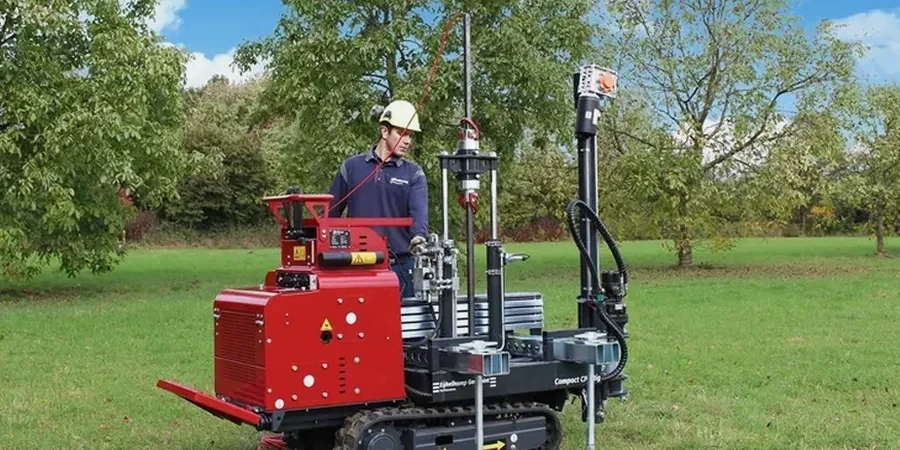
York sits at just 13 metres above sea level, where the River Ouse and Foss carve through layers of glacial till, laminated clays, and alluvial silts deposited over the Sherwood Sandstone. Building here means dealing with soft ground profiles that change within 50 metres. Our CPT (Cone Penetration Test) service captures cone resistance, sleeve friction, and dynamic pore pressure continuously through these transitions. A single push can reach 15 to 20 metres depth, feeding real-time logs to the site engineer. For coarser gravel pockets that stop the cone, we switch to spt drilling to recover disturbed samples and keep the investigation moving. BS EN 1997-2:2007 governs the procedure, and every push is referenced against the BGS superficial-deposits mapping for central Yorkshire.
A single CPT sounding in York's Ouse floodplain can replace three boreholes when the stratigraphy is laterally continuous clay.
Process and scope
Local ground factors
The most common mistake we see on York sites is assuming a uniform clay profile when the borehole log shows one metre of stiff till. The CPT often reveals a 400 mm peat layer or a loose silt lens that a cable-percussion borehole simply missed. Missing that lens leads to differential settlement in strip footings or excessive pile settlement when the toe sits just above the weak zone. We have also seen pore pressure equalisation failures where contractors skip dissipation tests and then face time-dependent settlement in flood-defence embankments. A single CPT with pore-pressure measurement clarifies the drainage regime and flags under-consolidated layers before the concrete pour.
Relevant standards
BS EN 1997-2:2007 — Ground investigation and testing, BS 5930:2015 — Code of practice for ground investigations, AGS 4 — Electronic transfer of geotechnical data
Other technical services
Piezocone (CPTu) Investigation
Continuous push with pore-pressure measurement at the u₂ position. Includes dissipation tests at target depths to estimate consolidation characteristics in York's laminated clays.
CPT-Logged Geotechnical Report
Corrected cone resistance, friction ratio, and SBTn classification delivered in AGS 4 format. Parameters for shallow foundation and pile design calculated per Eurocode 7.
Combined CPT and Rotary Drilling
When gravel lenses stop the cone, we follow with dynamic sampling or rotary coring to extend the ground model through the Sherwood Sandstone interface.
Typical parameters
Quick answers
How much does a CPT test cost in York?
For standard piezocone pushes in the York area, prices range from £140 to £200 per sounding, depending on depth, access constraints, and whether dissipation tests are required. Mobilisation is quoted separately based on distance and rig size.
How deep can the CPT rig penetrate in York's glacial till?
Our 20-tonne rig typically reaches 15 to 20 metres in the stiff till and clay formations found across York. Refusal occurs on dense gravel layers or the Sherwood Sandstone bedrock. When that happens, we switch to rotary drilling to continue the investigation.
What parameters does a CPT provide for foundation design?
The CPT delivers continuous profiles of cone resistance (qₜ), sleeve friction (fₛ), and pore pressure (u₂). From these we derive undrained shear strength, relative density, effective friction angle, and constrained modulus. For piled foundations, the data feeds direct methods for shaft friction and end-bearing capacity.
Is CPT suitable for the soft alluvial soils near the River Ouse?
Yes, CPT is particularly effective in York's floodplain deposits. The soft silts and clays west of the Ouse produce clean cone resistance profiles with clear transitions between layers. Dissipation tests in these soils provide reliable consolidation coefficients for settlement analysis.
How quickly can we get CPT results on a York site?
Field data is visible in real time on the acquisition screen. We typically deliver the processed AGS 4 file and preliminary soil behaviour type logs within 24 hours of completing the soundings. Full interpretative reports follow within three working days. More info.