York’s two millennia of continuous occupation have left a complex subsurface legacy that directly shapes modern tunnelling practice. The city sits astride the River Ouse, underlain by Quaternary alluvium and the laminated clays of the Vale of York Formation, which exhibit pronounced strain-softening behaviour when disturbed. Archaeological strata, medieval cellars, and Victorian brick sewers add further heterogeneity within the first six metres below ground. Because tunnel alignments here frequently pass beneath the York Minster precinct and the Grade I listed city walls, settlement tolerances are exceptionally tight. The team correlates historic borehole logs from the British Geological Survey with modern CPT testing to map the lateral extent of soft zones, and we integrate seismic refraction profiles where buried channel features complicate the bedrock interface. A reliable geotechnical analysis for soft soil tunnels in York demands this layered understanding of natural geology and anthropogenic deposits before any face pressure or support class is selected.
Stiffness degradation at 0.1–1% strain governs settlement predictions in York’s laminated clays far more than ultimate strength parameters.
Process and scope
Local ground factors
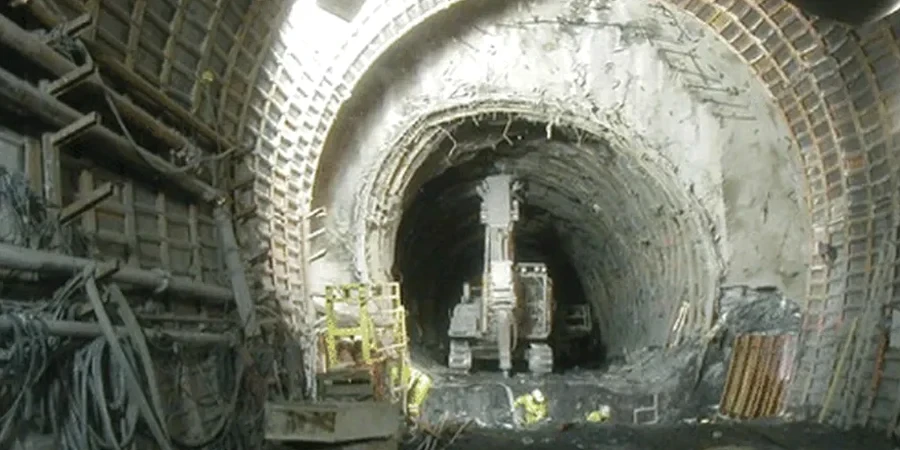
York’s population of approximately 210,000 and its status as a premier heritage destination concentrate risk along any tunnelled corridor. The greatest technical hazard is face instability triggered by undrained unloading of sensitive clays, a mechanism well documented in the Engineering Geology of British Rocks series for the Vale of York. When the tunnel boring machine advances through a lens of laminated silt with St values exceeding 6, remoulding at the cutterhead can propagate a collapse chimney that daylights unpredictably through archaeological layers. Secondary hazards include consolidation settlements beneath the York Minster foundations, where differential movement exceeding 5 millimetres could activate cracking in the 15th-century masonry. We address this through coupled flow-deformation analyses in PLAXIS 2D, explicitly modelling the permeability anisotropy (kv/kh ratios of 0.1–0.3) that controls pore pressure dissipation time. Groundwater lowering in the Sherwood Sandstone aquifer, which underlies the glacial sequence at depths of 15–25 metres, introduces a further long-term risk of regional subsidence that our geotechnical analysis for soft soil tunnels in York quantifies through fully coupled Biot consolidation runs.
Relevant standards
BS 5930:2015+A1:2020 – Code of practice for ground investigations, Eurocode 7: BS EN 1997-1:2004+A1:2013 – General rules, BS EN 1997-2:2007 – Ground investigation and testing, BS EN ISO 17892 series – Laboratory testing of soil, BS EN ISO 22476 series – Field testing (CPT, SPT, etc.)
Other technical services
Advanced laboratory testing for soft ground
CRS oedometer tests provide continuous compressibility curves for the laminated clays, while K0-consolidated undrained triaxial tests with local strain transducers define the effective stress path to failure. We also run bender element measurements on each specimen to establish the small-strain stiffness envelope required for HSsmall parameter calibration in PLAXIS.
Piezocone profiling and pore pressure analysis
CPTu soundings with dissipation tests at 2-metre intervals map the undrained shear strength profile and the in-situ coefficient of consolidation. The data are corrected for the non-standard penetration rate effects reported in stiff laminated facies, following Lunne et al. (1997) procedures, to avoid overestimation of cu.
Settlement and face stability modelling
Using the derived parameters, we build finite-element models that simulate TBM advance step-by-step, incorporating face pressure, shield conicity, and tail-void grouting. Outputs include transverse settlement troughs validated against the Gaussian curve method of Peck (1969) and volume loss estimates constrained to below 1.0% for sensitive structures.
Typical parameters
Quick answers
What is the typical cost of a geotechnical analysis for a soft soil tunnel in York?
The investigation scope depends on tunnel length, depth, and proximity to heritage structures. A comprehensive package combining CPTu soundings, undisturbed sampling, advanced laboratory testing (CRS, triaxial with bender elements), and 2D finite-element settlement modelling generally ranges from £3,070 to £12,520. Smaller campaigns focused on a single shaft or short drive fall at the lower end, while full alignment characterisation with real-time monitoring instrumentation reaches the upper bound.
Which soil parameters are most critical for tunnelling in York’s laminated clays?
Small-strain shear modulus (G0) and its degradation curve (G/G0 versus log shear strain) are paramount, because they control settlement predictions at the 0.1–1% strain range typical of closed-face TBM excavation. Undrained shear strength anisotropy, expressed as the ratio of triaxial compression to extension cu values, governs face stability calculations. The coefficient of consolidation from CPTu dissipation tests dictates the rate of pore pressure equalisation around the annulus grout.
How do you account for archaeological deposits in the ground model?
We treat the anthropogenic layer (0–6 m) as a distinct geotechnical unit with highly variable density and stiffness. Desk-study correlation of historic Ordnance Survey maps and York Archaeological Trust records identifies potential voids, cellars, and backfilled sites. The ground model explicitly assigns lower stiffness and higher permeability to these zones, and we recommend cross-hole seismic tomography between boreholes to image hidden anomalies before the TBM cutterhead enters the section.